












|
|
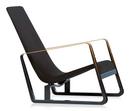
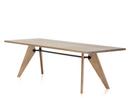
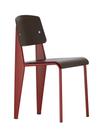
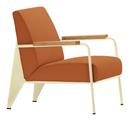
Jean Prouvé
| |

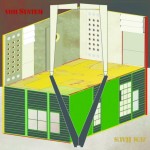
Jean Prouvé (* 8. April 1901 in Paris/France; † 23. March 1984 in Nancy/France), was trained as a metal
artisan under Emile Robert, Enghien und Szabo in Paris. In 1924 he opened his own workshop in Nancy and
began to produce his first furnishings made of formed sheet steel in 1925. He was a founding member of
the Union des Artistes Modernes (UAM) in 1930. In the following year he established his own manufacturing
firm, Les Ateliers Jean Prouvé. During the 1930s, the company produced numerous furniture designs, as
well as some of the first prefabricated architectural elements, including components for the Maison du
Peuple in Clichy (in collaboration with the architects Beaudoin and Lods), whose steel-and-glass structure
attracted a great deal of attention. Due to the scarcity of steel during the Second World War, Prouvé
constructed wood furniture and developed simple houses made out of prefabricated parts. Active in the
French Résistance, Prouvé was elected mayor of Nancy after the city was liberated. He designed and
constructed residential buildings for the homeless. In 1947 he established the Maxéville factory, a
facility of 25,000 square meters in which furnishings, prefabricated homes and schools were produced
by 200 employees. Among the most famous pieces from Prouvé's Maxéville production included the Bahut
sideboard. Due to disagreements with the majority shareholders, Jean Prouvé left the company in 1953.
After working as head of the construction office of the Compagnie Industrielle de Matériel de Transport
(CIMT) in Paris between 1957-68, Prouvé ran his own architectural consulting firm in Paris from 1968-84.
He taught as professor at the Conservatoire des Arts et Métiers (CNAM) from 1957-70. As chairman of the
jury for the Centre Pompidou architectural competition in 1971, he played a major role in selecting the
design of Renzo Piano and Richard Rogers. Between 1980-84, Prouvé again turned his attention to the further
development of his furniture designs. In many of his works, Jean Prouvé achieved the goal of uniting
functional requirements, the honest use of materials and economical concerns with the complex demands
of mass production. Beginning in 2002, and in close collaboration with the Prouvé family, Vitra has
devoted itself to the re-edition of numerous designs by this great constructeur.
|
 |
|
 |
|
 |
|
 |
|
 |
|
 |
|
Last update 11.03.2010 08:47
|
|
Last update 11.03.2010 08:48
|
|
Last update 11.03.2010 08:47
|
|
Last update 11.03.2010 08:46
|
|
Last update 11.03.2010 08:48
|
|
 |
|
 |
|
 |
|
 |
|
 |
|
 |
| |
 |
|
 |
|
 |
|
 |
|
 |
|
 |
|
Last update 11.03.2010 08:48
|
|
Last update 11.03.2010 08:48
|
|
Last update 11.03.2010 08:46
|
|
| |
 |
|
 |
|
 |
|
 |
|
 |
|
 |
| |
More about 'Jean Prouvé' in our blog ...und präziser Ingenieurskunst. Die 6631 Luxus wurde vom Silberschmied und Bauhaus-Meister Christian Dell entworfen und ist ebenso durch das geschmeidige, asymmetrische Design...ein Klassiker des Bauhaus-Designs der 1930er Jahre. Außerdem ist sie jetzt bei smow.de erhältlich....
...or there functionality are universally known and admired. To this group belongs the so-called 'Bauhaus Lamp from Wilhelm Wagenfeld. The Bauhaus Lamp officially known...offer the copyrighted and from Prof. Wagenfeld authorised edition. Wilhelm Wagenfeld designed the 'Bauhaus Lamp during his time at Bauhaus in Weimar in the early 1920s. He was fascinated...
...smow has a wide range of wardrobes and hanger systems to suit every taste - and jacket type....smow has a wide range of wardrobes and hanger systems to suit every taste - and jacket type....
|