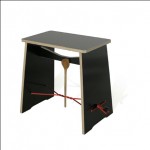
























The Ulmer Hocker: Idea ─ Icon ─ Idol at the HfG-Archiv, Ulm
...The HfG Ulm: Idea - Icon - Idol - Bauhaus Arising from the Ulmer Volkshochschule, a post-War institution initiated by Inge Scholl and Otl Aicher concerned with re-establishing democratic education in Germany following the years of Nazi dictatorship, doctrine and dogma, the Hochschule für Gestaltung, HfG, Ulm formally commenced teaching in August 1953 with the Bauhäusler Max Bill as inaugural rector, and Bauhäusler such as, and diverse as, Helene Nonné-Schmidt, Walter Peterhans or Josef Albers amongst its earliest teaching staff... A primacy Max Bill was very much an adherent of, or as he opined in 1952, "designers who realise new forms are consciously or unconsciously reacting to trends in contemporary art because it is in art that the intellectual and spiritual currents of every epoch find their visible expression"...