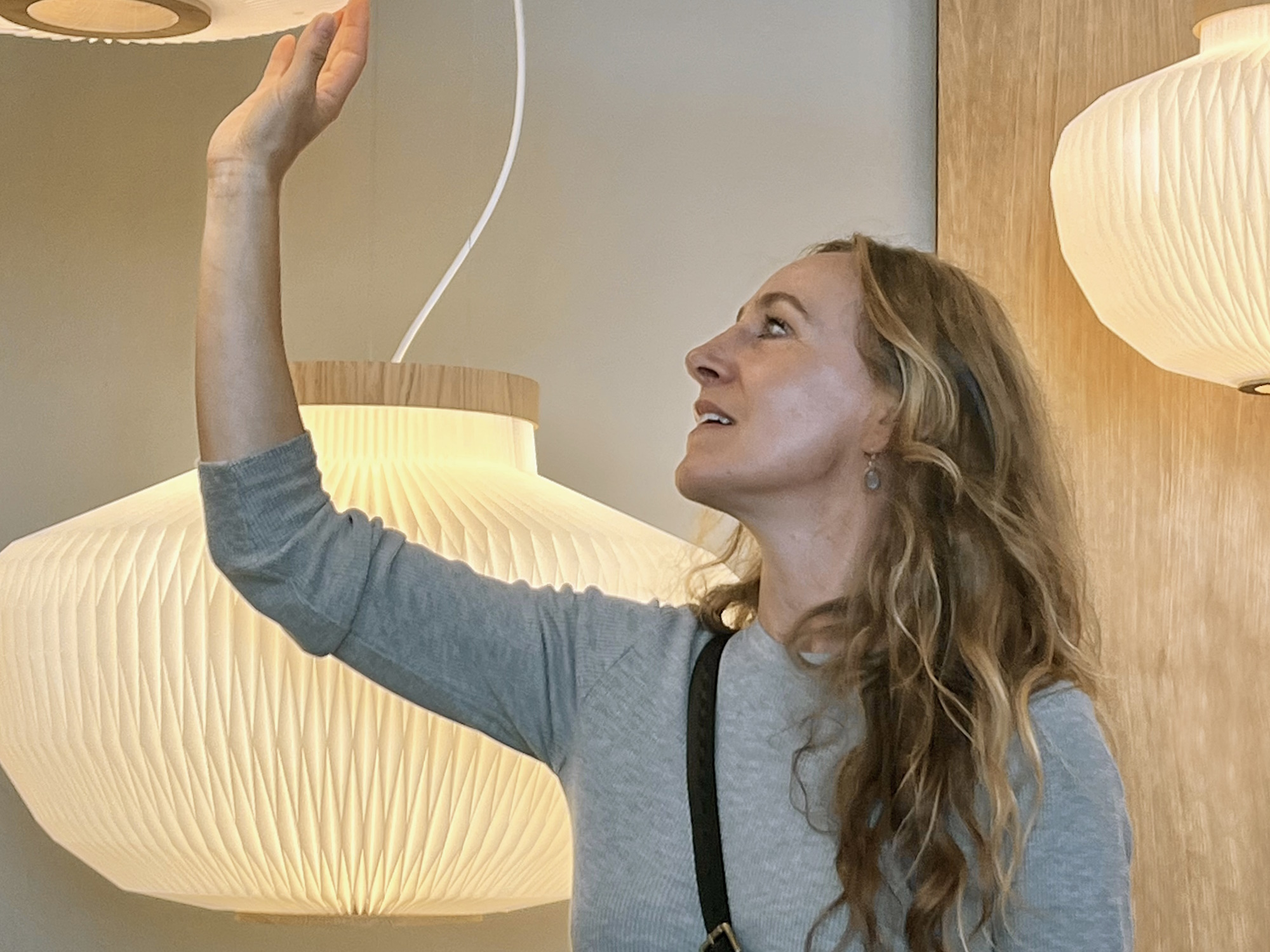
Good design sometimes begins with taking a closer look. Jette Scheib observes her surroundings, the people and the objects that surround her in everyday life – and time and again finds new starting points for her designs in them. Born in Germany, she studied product design at the Berlin University of the Arts (UdK) and set up her own studio after graduating in 2005. Initially, she mainly created home accessories and gift items for international companies. In 2009, she returned to the UdK as a design lecturer for three years, before increasingly focusing on interior and lighting design from 2018 onwards.
Jette Scheib now lives and works in the Netherlands, where she moved for love. She draws her inspiration directly from her surroundings: from the organic forms of nature as well as from everyday situations and the interplay between people and objects. With the ‘Urchina’, she has now designed a lamp for Le Klint that brings together precisely this interest in form, function and our everyday interaction with objects.
We spoke to Jette Scheib about the creation of the Urchina for Le Klint and her work as a designer – from her sources of inspiration to the design process.
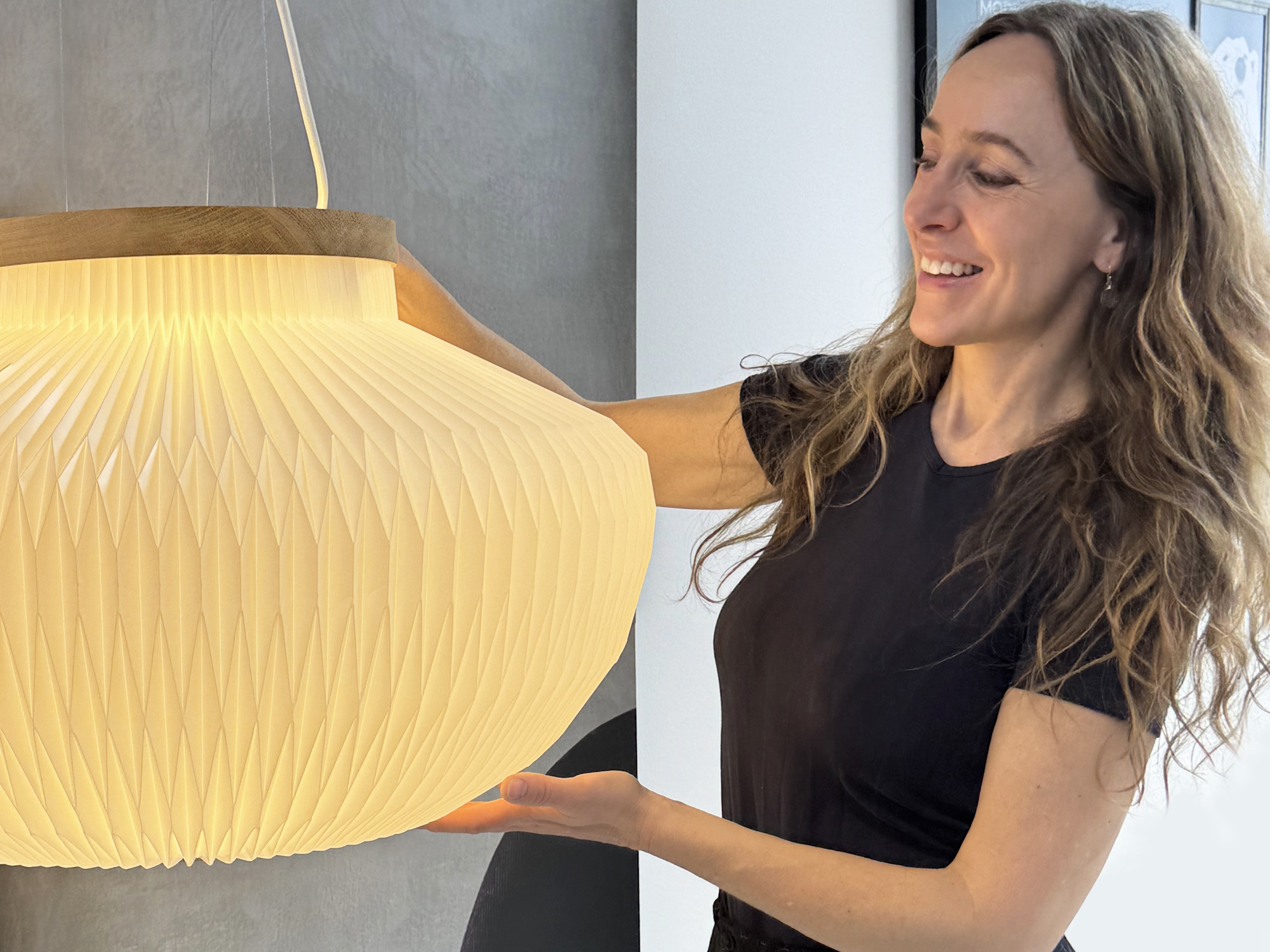
smow: The Urchina was unveiled for the first time this year as part of 3daysofdesign in Copenhagen. What was it like for you to showcase the lamp there for the first time?
Jette Scheib: Danish design has long been an important part of international design history. Le Klint’s pleated lamps are iconic and form part of Denmark’s design heritage – unmistakable and recognised worldwide. The Urchina was my first collaboration with Le Klint. I am very happy and feel honoured to have been given the opportunity to develop my own interpretation of a Le Klint lamp, which has now become part of the beautiful Le Klint collection. It was very exciting to see my lamp on display during the 3daysofdesign at Le Klint’s showroom in the heart of Copenhagen.
smow: What was the starting point for the design of the Urchina – was there a particular moment, an idea or an object that inspired you?
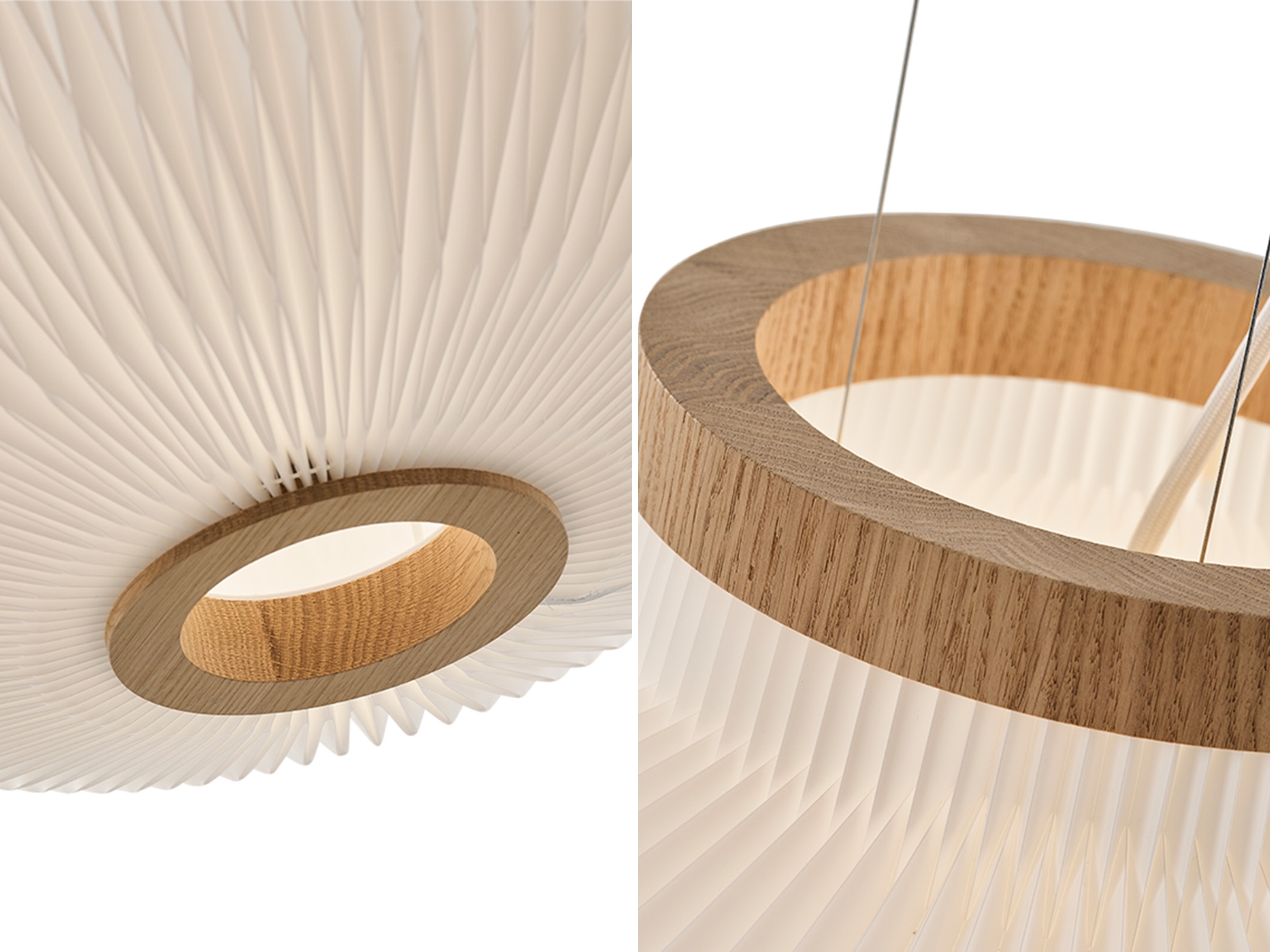
Jette Scheib: The distinctive aesthetic of Le Klint lights is defined by their folding technique. Following a precise pattern, a single sheet of paper is transformed into a sculptural, round object. Nothing is random or purely decorative – everything follows a clear order, and yet the result is a distinctly decorative object. The shell of a sea urchin is constructed in a similar way. Its organic form, too, is based on an almost architectural system of repetition, in which the pattern determines both the structure and the appearance. The sea urchin became my inspiration, and the name Urchina is derived from the English term ‘sea urchin’.
smow: What makes the Urchina a special lamp for you – and how does it differ from your previous designs?
Jette Scheib: My work with Le Klint began out of sheer curiosity. I wanted to find out how the folding technique works, so I started experimenting with how different volumes could be created and folded. It was fascinating and great fun. This process resulted in a few interesting objects – including Urchina. What makes Urchina special to me is the very physical and intuitive way in which it came about. Unlike many of my previous designs, I couldn’t simply draw it in 3D on the computer and predict the final result. I had to discover the complexity of the folding process through the actual act of making it. The lengthy process of folding each individual prototype also created a special connection and familiarity with the object that I had never experienced before.
smow: What fascinates you most about designing lights?
Jette Scheib: Light gets people together. It sets the mood of a room and can completely transform the way a room feels. Even in the most comfortable armchair, you won’t be sitting comfortably if the lighting in the room isn’t right. As well as the important function of lighting, I love the artistic freedom that decorative lighting design offers. A light fitting can be more than just a source of light – it can be a sculptural object, a statement piece or the centrepiece of a room.
smow: The Urchina is a very distinctive piece. How important is it to you that a design acts as an eye-catcher in a room?
Jette Scheib: I believe that decorative lights should lend a room atmosphere and character. I want my lights to be good company – to provide light, but also to be something you enjoy having around you and with which you can form a connection. For me, an eye-catcher isn’t about demanding attention, but about a presence that brings warmth and a sense of familiarity to a room.
smow: Was there a moment during the development process when Urchina took a decisive turn?
Jette Scheib: Once I had created this form, which reminded me of a sea urchin, I felt that something warm was missing to emphasise its organic shape and character. With the addition of the wooden elements, the moment arrived when the Urchina suddenly seemed to breathe and come to life.
smow: How does your perspective on a design change when you see it in a real room for the first time?
Jette Scheib: I’m always a bit nervous when I see a finished design for the first time, because as designers we’re often our own harshest critics. But Le Klint has brought my design to life beautifully. The quality, the materials and every little detail were exactly as I’d hoped.
smow: How did you go about choosing the materials and finishes? What was particularly important to you in this process?
Jette Scheib: The folding technique developed by P. V. Jensen-Klint was originally inspired by Japanese origami. I wanted to reflect this fusion of Japanese and Nordic influences in my choice of materials as well. Urchina is folded from a warm white lampshade foil that is robust and easy to clean, yet has the appearance of paper. To incorporate the Danish element into the design, I chose warm, light-coloured oak to contrast with the white shade. For me, this combination brings together both influences – the Japanese origins of the folding technique and the warmth and simplicity of Nordic design.
smow: The Urchina is now also available from smow. Where would you most like to use it yourself – and which piece of furniture or object would you pair it with?
Jette Scheib: I imagine Urchina on its own or in a small group in a bright, airy room, perhaps above an oak table. A Scandinavian or Japanese-inspired setting would suit it very well, particularly with a few wooden elements and simple, timeless furniture. I’m very keen to see how interior designers and architects will work with the Urchina range. I can’t wait to see the different visions and concepts they’ll develop around the lamp, and how it will interact with different spaces, materials and pieces of furniture. For me, that’s one of the most interesting aspects when a design is launched – seeing how it takes on a life of its own.
smow: Have you had any personal experiences where being a woman in design made a difference?
Jette Scheib: Design is still a male-dominated profession. One might think this has something to do with an understanding of electrical engineering – something that is still, quite wrongly, generally attributed to men. But even in fashion design, the proportion of male designers in leadership roles remains higher. I think that many young female designers allow themselves to be intimidated or even put off from taking the plunge into self-employment. I, too, have encountered men in the industry along the way who were unwilling to see me as a potential business partner. It’s a great shame – for both sides. When it came to bringing my designs to life, there have also been instances where changes were made to my sketches without consulting me, because it was assumed that my proposed solution was ill-conceived or flawed. Consequently, the result wasn’t as desired and had to be corrected afterwards.
A big ego, a self-assured demeanour and a certain degree of arrogance are often perceived as signs of competence in men, whereas in women they tend to be seen as ‘pushy’ or off-putting. As a result, neither holding back nor boasting really helps us women.
To put it briefly: women often find it harder to get a foot in the door and gain trust. However, once a working relationship is established, it is precisely those qualities often described as ‘feminine’ – friendliness, patience, attention to detail, understanding and reliability – that are highly valued. And it is precisely these qualities that can form the basis for long-standing and successful business partnerships.
smow: What advice, insights or inspiration would you offer to young female designers today who are currently seeking to find their own voice in the world of design?
Jette Scheib: Above all, I’d like to encourage young female designers not to let themselves be put off or intimidated. Don’t lose your joy in designing and, above all, don’t lose your self-belief – no matter who or what you encounter along the way. A rejection, or even no reply at all to a design you’ve submitted, doesn’t automatically mean the design is bad. Perhaps it simply doesn’t fit with the collection a company is currently working on. Perhaps they like the idea, but it’s too expensive to produce. There are countless reasons for a rejection – and often simply not enough time for a detailed explanation. That’s why it’s important to stay in touch, keep the dialogue going and maintain a positive attitude. Maybe it’ll work out next time. And if not, then perhaps the time after that.
smow:If you see design as a language or a medium, what message would you, as a designer – and particularly as a woman – like to convey to the world today?
Jette Scheib: I would like to see greater emphasis placed on quality, durability and sustainability in both the design and manufacturing processes. For me, this also includes choosing manufacturers responsibly – taking into account the environment, working conditions and human rights. I would also like to see the selection of designers depend more on the quality, level of innovation and utility of a design, and less on the designer’s fame or name. What matters is the product and what it can offer us and how it can be of use to us. It’s not about who made it. So, if I view design as a language, I believe we’re engaging in too much small talk. We should choose our words more carefully in order to have good, profound and moving conversations. I am particularly pleased, in this regard, with my recently launched collaboration with the Danish lighting company Le Klint. The company focuses on high-quality products, timeless design, sustainable and recyclable materials, and a conscious commitment to local, handcrafted production. The lampshades are pleated in the company’s own workshop, and the metal and wooden components used also come from Denmark.
For me, this approach to manufacturing embodies precisely the ethos I hope to see in the future of design: less short-lived consumption and greater appreciation for a well-made, durable product.
smow: Thanks a million, Jette!