The 3daysofdesign event in Copenhagen usually features showrooms from major brands, new collections, experiments with materials and the latest trends in Scandinavian design. But if you only look to the future, you’ll quickly miss the very thing that made the present possible in the first place: the places where design history wasn’t merely exhibited, but actually created. The SAS Royal Hotel, now the Radisson Collection Royal, is precisely such a place: a building that not only showcases design but is itself a central landmark of modern Scandinavian design. That is why, during 3daysofdesign, we also took the time to visit the famous hotel. And it is well worth taking this look back. For the building feels less like a monument and more like an idea that continues to have an impact to this day.
In the mid-1950s, the Scandinavian airline SAS planned a hotel that was to be more than just a place to stay. It was about identity. Aviation had transformed travel: making it faster, more international and a matter of course. SAS wanted to translate this new era into a physical space – as an expression of a modern, open Scandinavia. When the SAS Royal Hotel opened its doors in the summer of 1960, Copenhagen suddenly had a building that we would today describe as a design icon – long before the term even existed. A place that makes the promise of modernity visible even before you take your first step into a room.
Arne Jacobsen was chosen for this task – a logical decision that was hardly, if at all, a matter of chance. Jacobsen had established himself as a central figure of Danish Modernism in the 1950s. His architecture combined clarity with atmosphere, rationality with precision in the details. However, something else was decisive: he did not view design in terms of separate disciplines, but as a coherent system. For him, architecture did not end at the wall. Furniture, lighting, materials, signage and even the smallest everyday objects were all part of the same design brief. This was precisely what SAS was looking for: not an architect for a hotel, but a designer to create a brand identity within the space. So he got the job.
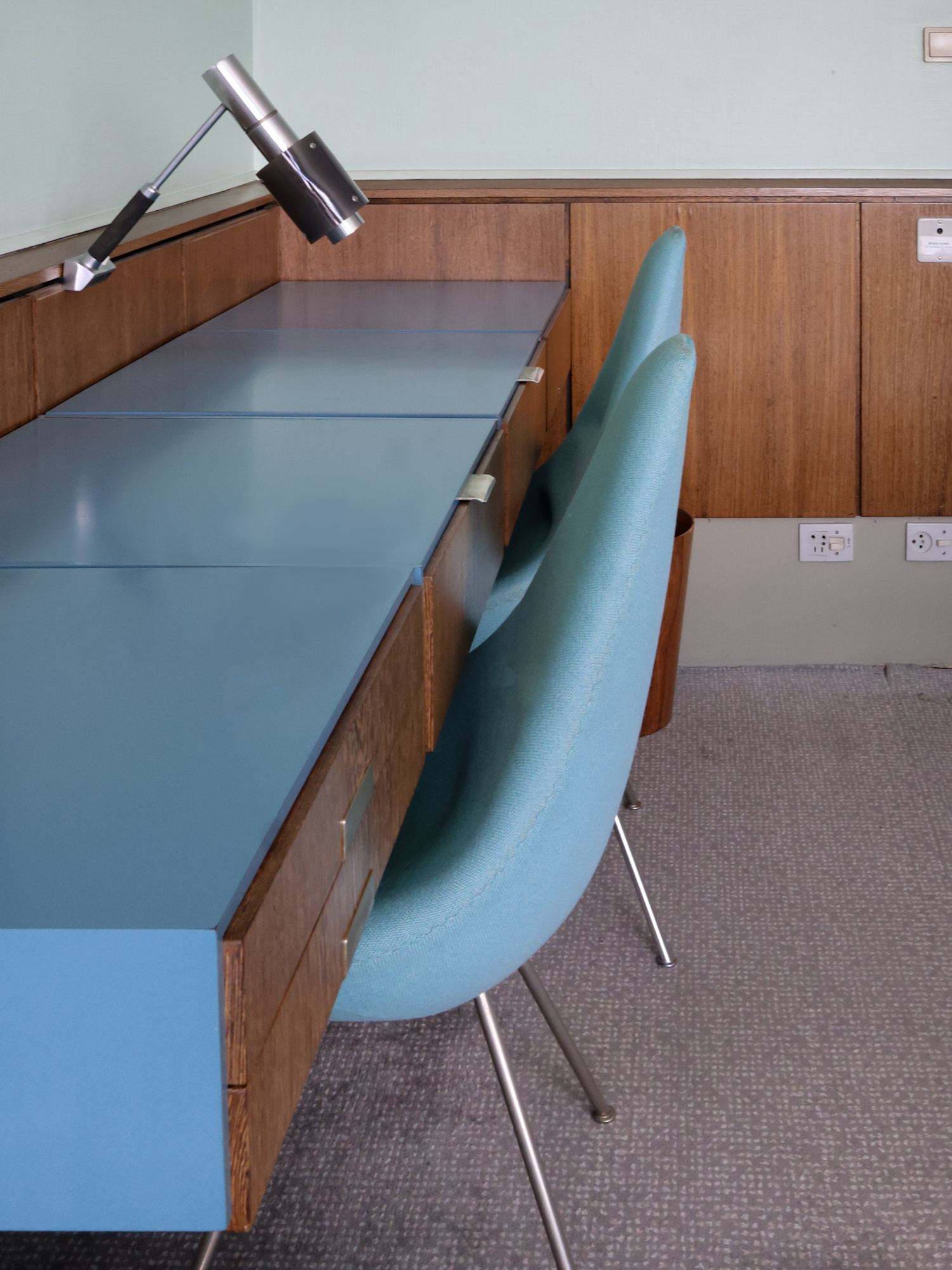
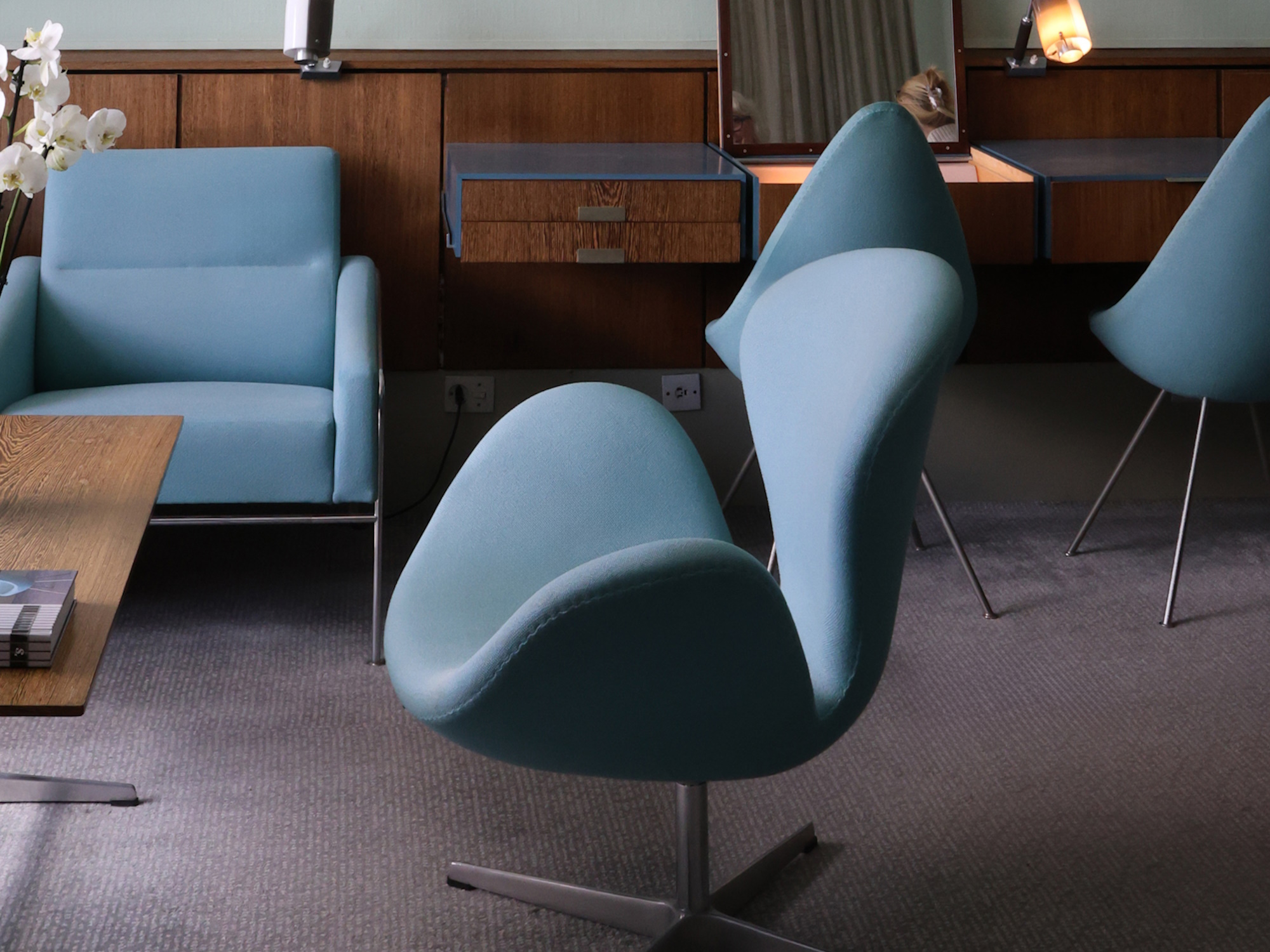
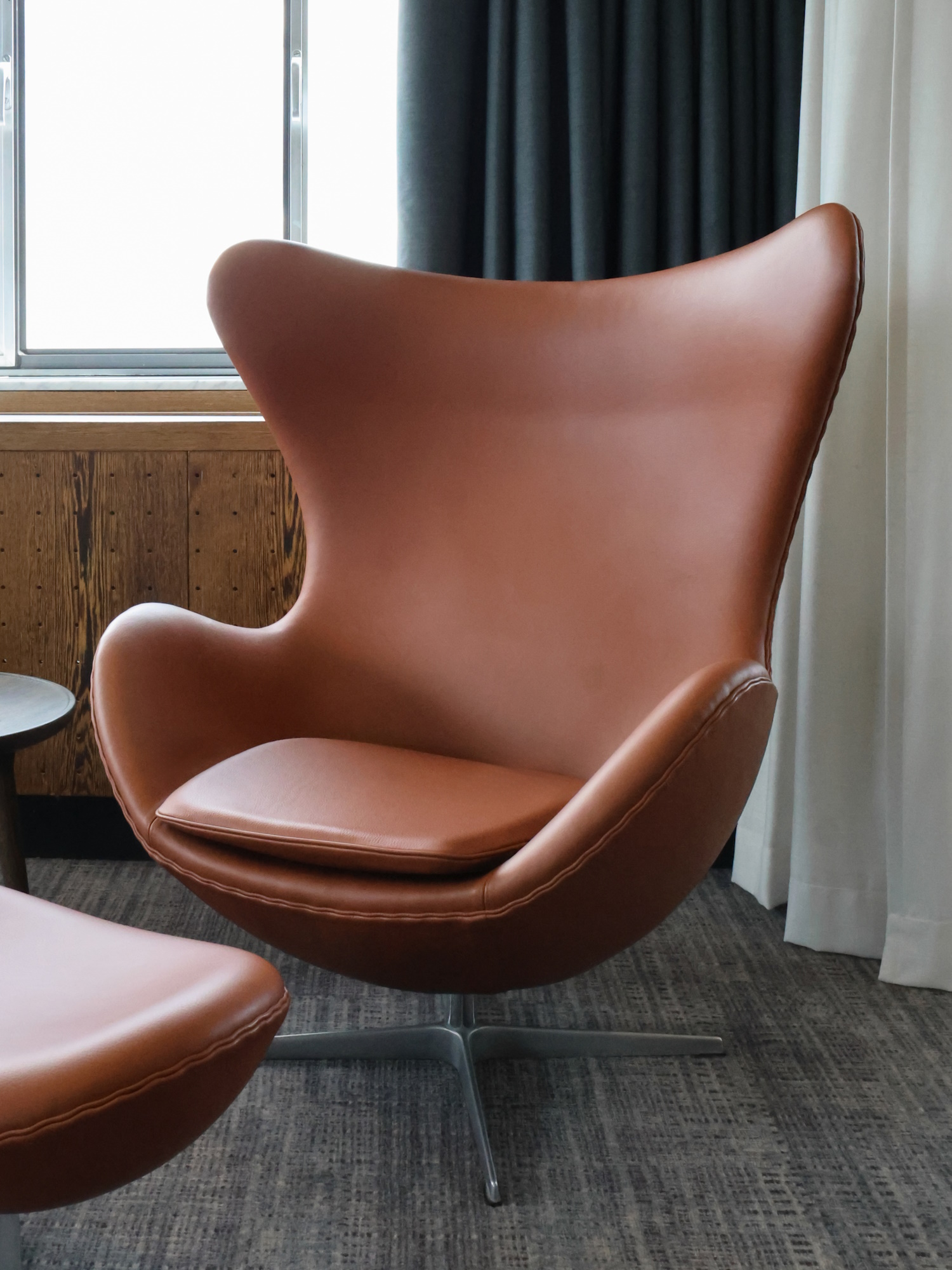
Some of the 20th century’s best-known furniture designs were created for the SAS Royal Hotel – not as standalone design objects, but as direct responses to specific spatial contexts. The Egg Chair and the Swan Chair were developed for the lobby and lounge areas. Jacobsen sought forms that could counterbalance the austere architectural grids with something organic. The Egg Chair, in particular, creates a space within a space – a sheltered zone within the open hotel landscape. The Drop Chair, designed for the restaurant areas, reveals a different side: minimalist, functional, almost playfully light. Long overlooked, it was only brought back into production by Fritz Hansen in 2014. What is important here is not so much the individual history of these pieces of furniture as their origin: they were not created as products to be placed in a space. They emerged from the space itself.
What really sets the SAS Royal Hotel apart is not the individual furniture designs, but the way in which they came about. Jacobsen did not design furniture that was subsequently placed in the hotel. He designed spaces – and created the matching furniture at the same time. As a result, the Egg, Swan and Drop chairs do not appear as outstanding individual pieces, but as natural components of a larger whole. Their impact only comes to life through their interplay with light, materials, colours and architecture. Perhaps this also explains why so many of today’s interiors remain strangely interchangeable, despite featuring iconic furniture. They start with the product. Jacobsen started with the space.
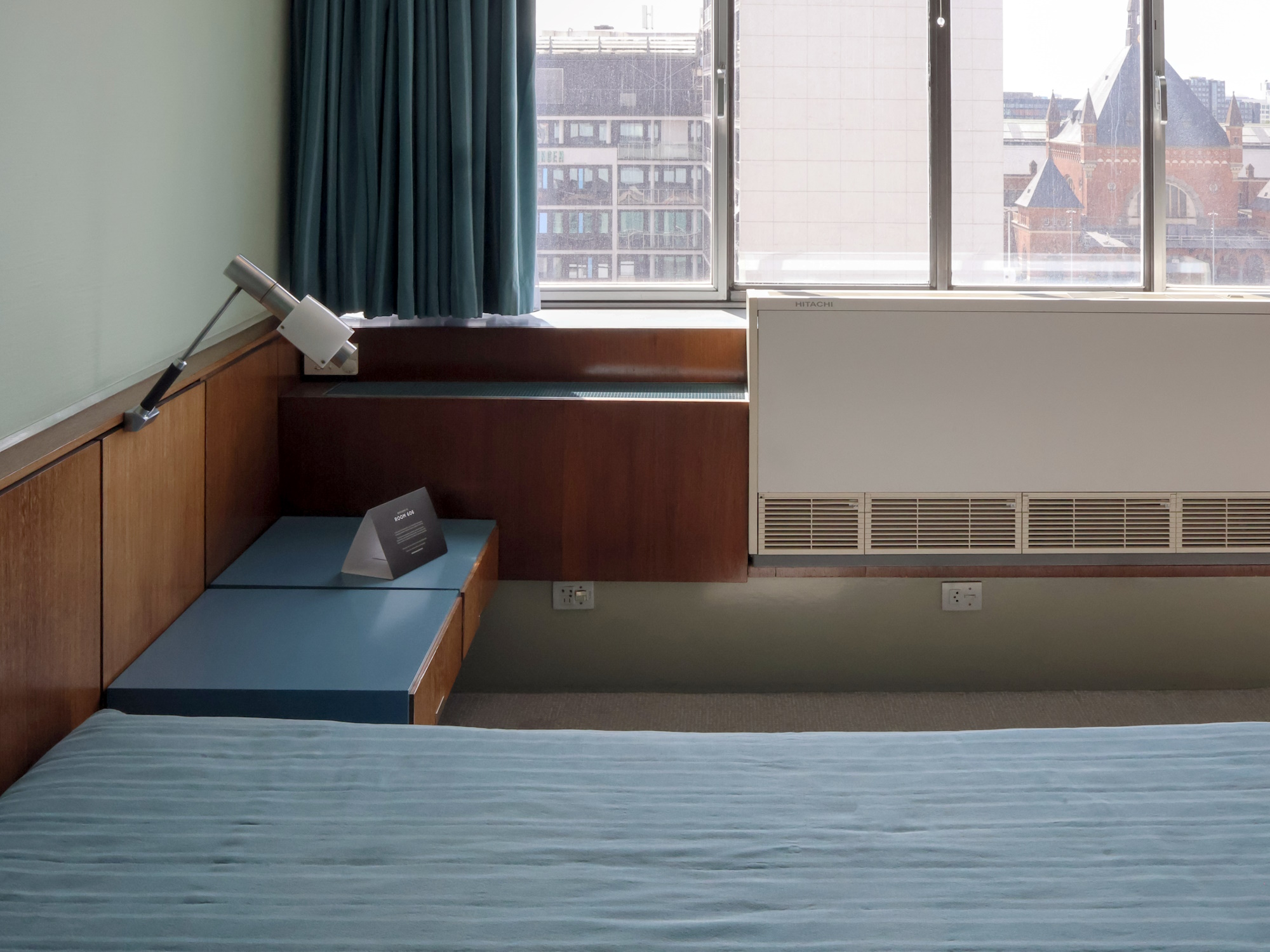
What makes it truly unique, moreover, is that the room’s basic design has been preserved to this day. Room 606 is regarded as one of the few suites from Jacobsen’s original design that remains virtually unchanged. Not only do the colour scheme and materials correspond to the 1960 design, but much of the furniture has also been preserved in its original form. As a result, the room feels less like a reconstruction and more like a rare, intact fragment of the overall concept – a place where Jacobsen’s vision of space, light and objects can still be directly experienced.
For a long time, the suite could even be booked as normal. Today, Room 606 serves primarily as a walk-in time capsule and can be viewed on request. It is precisely for this reason that the room holds special significance: it is not only a reminder of the SAS Royal Hotel of 1960, but also one of the few surviving examples of Jacobsen’s vision of architecture and design as an inseparable whole.
More than 65 years after it opened, the SAS Royal Hotel still feels remarkably contemporary. Perhaps this is partly because it answers a question that continues to occupy not only designers to this day: why do some spaces feel harmonious – whilst others, despite their iconic furniture, do not? Jacobsen did not seek the answer in individual objects. He did not design rooms that were subsequently furnished. He developed spaces from which furniture, materials, light and colours emerged logically. Architecture, interior design and furnishings do not appear here as separate disciplines, but as expressions of the same idea. The hotel’s true quality therefore lies not in the details, but in the coherence of the whole. And this is precisely where its relevance lies: it serves as a reminder that space is never created by objects alone – but by the interplay between pieces of furniture, between furniture and colours, between light and lighting, and between function and form. Perhaps this is why this building does not feel like a chapter in design history, but rather like an idea that continues to evolve to this day.