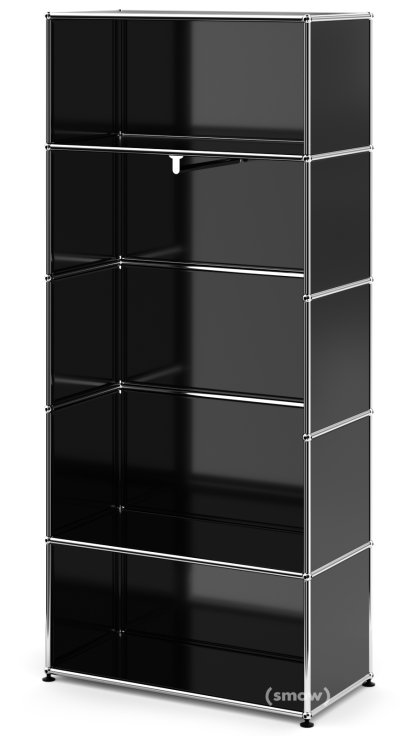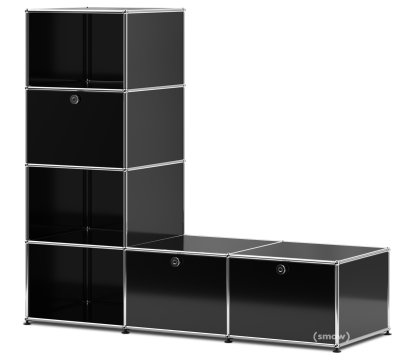











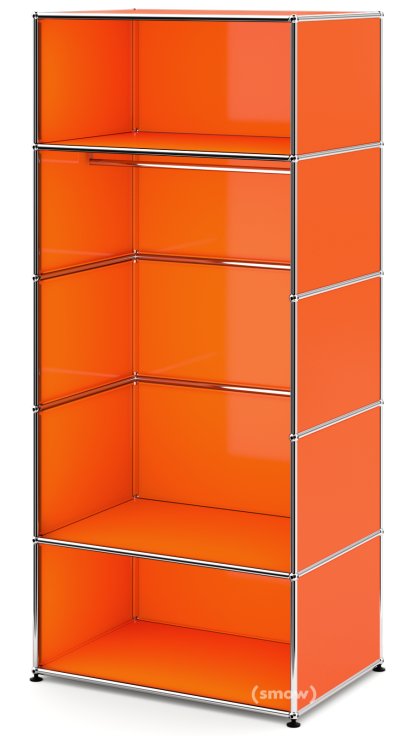

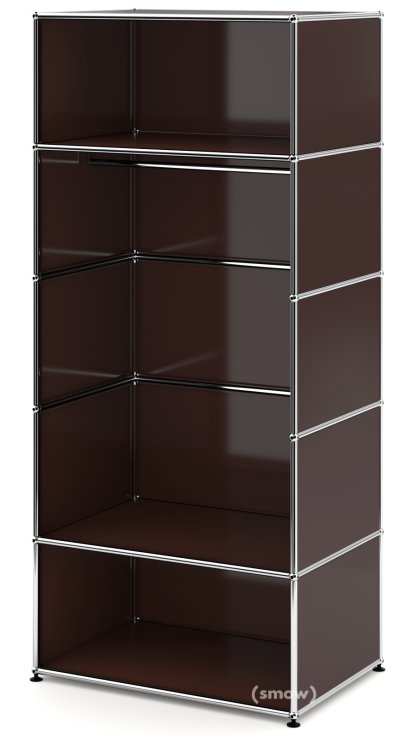
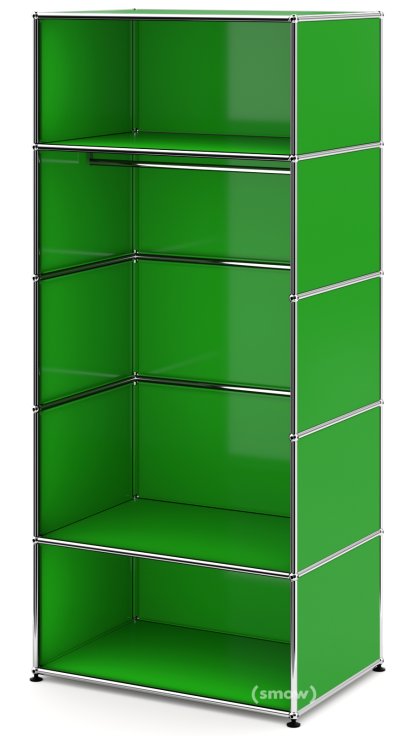
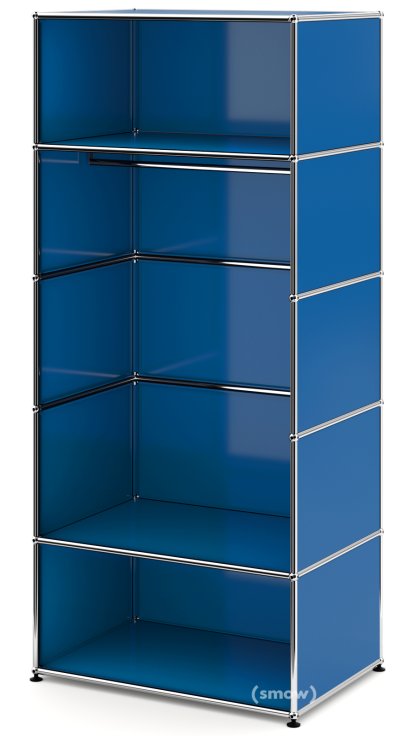
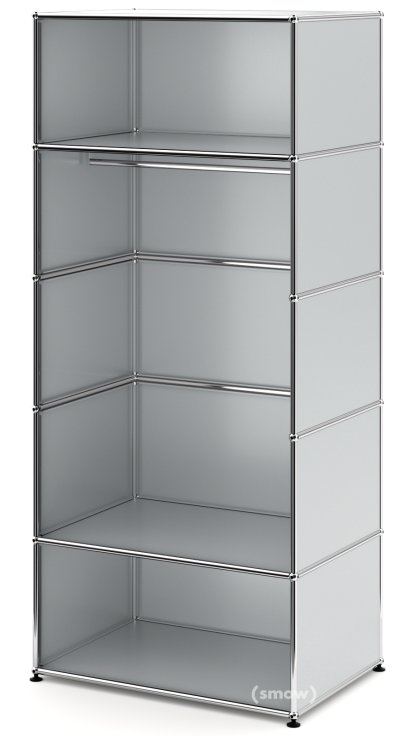
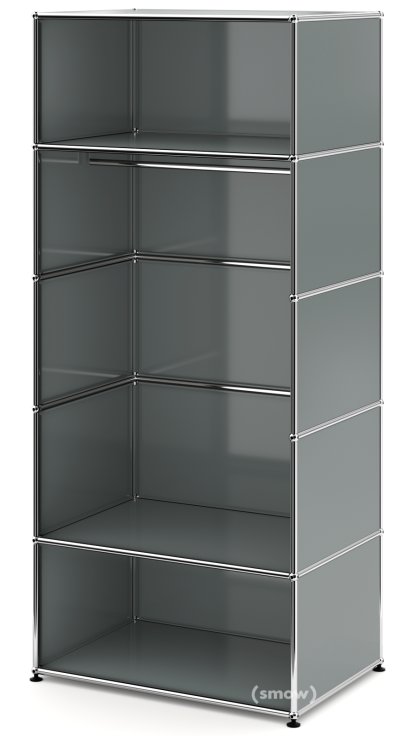
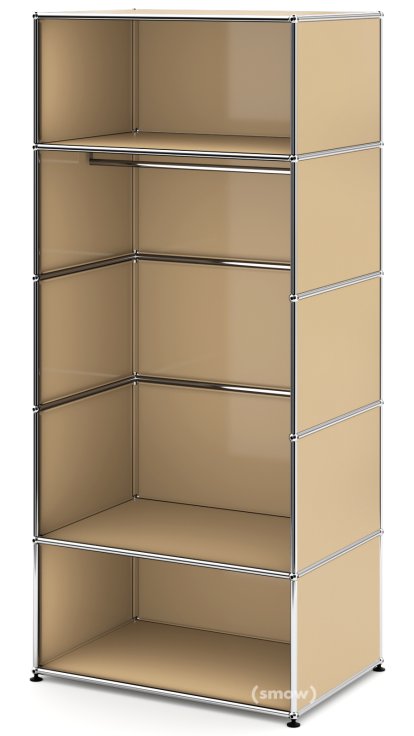
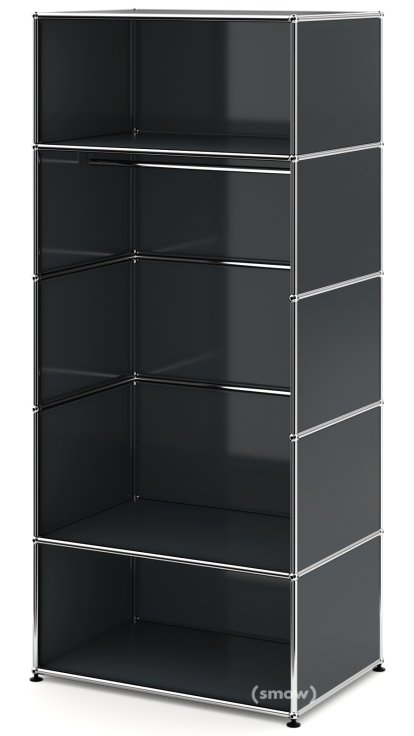
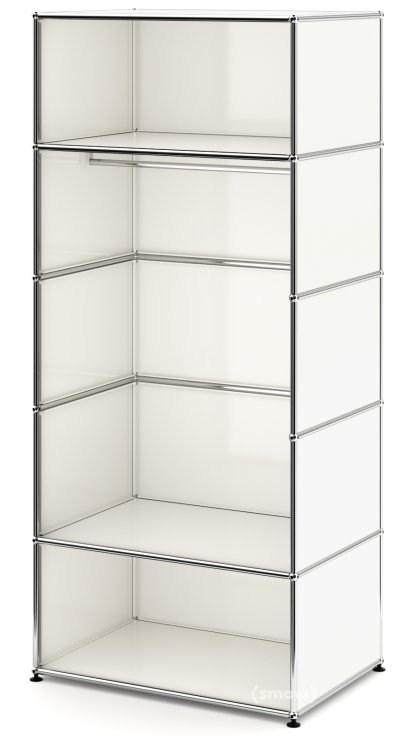
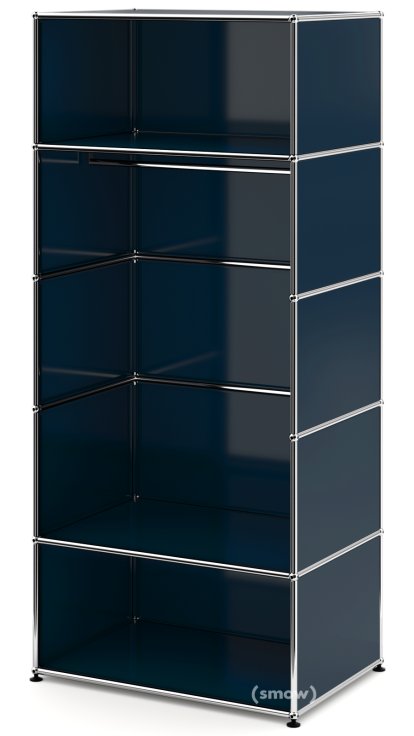
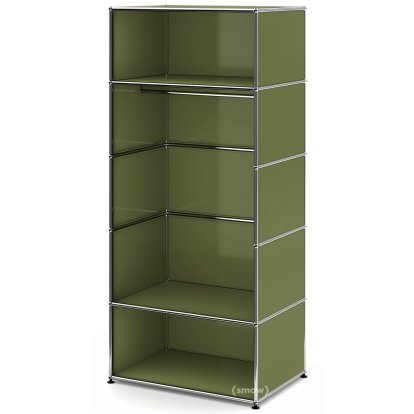
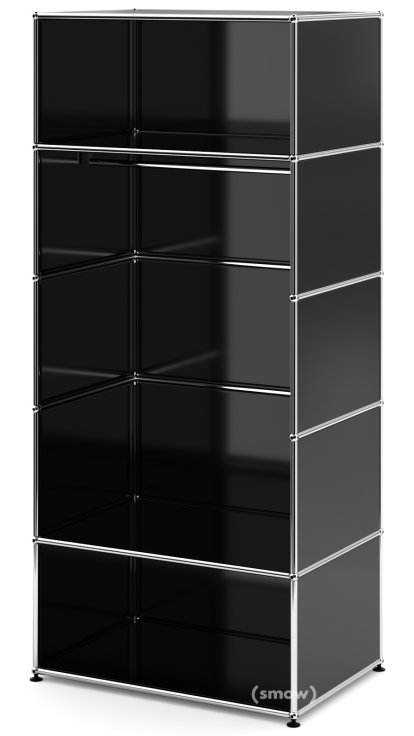
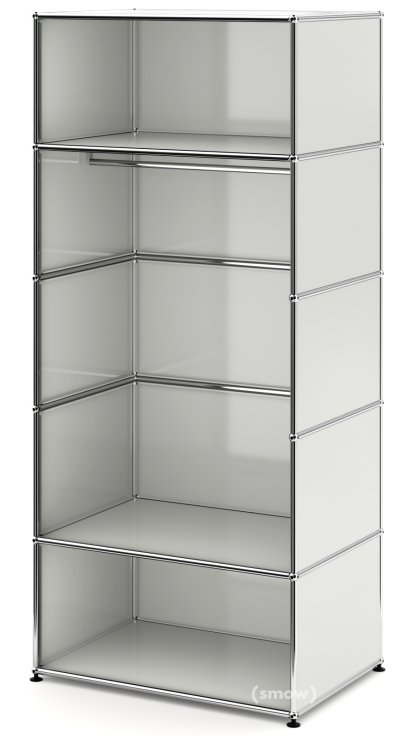
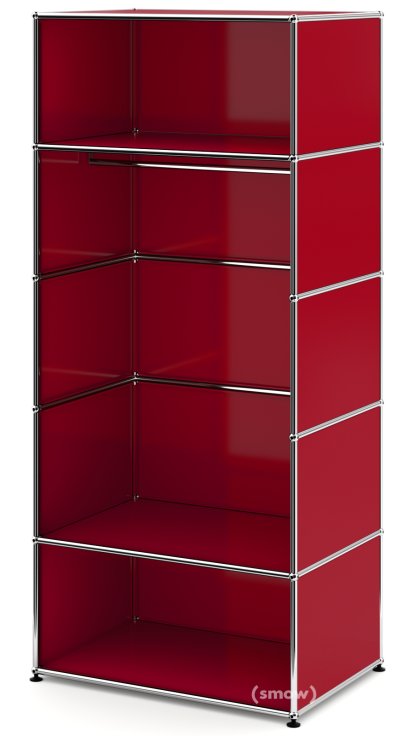
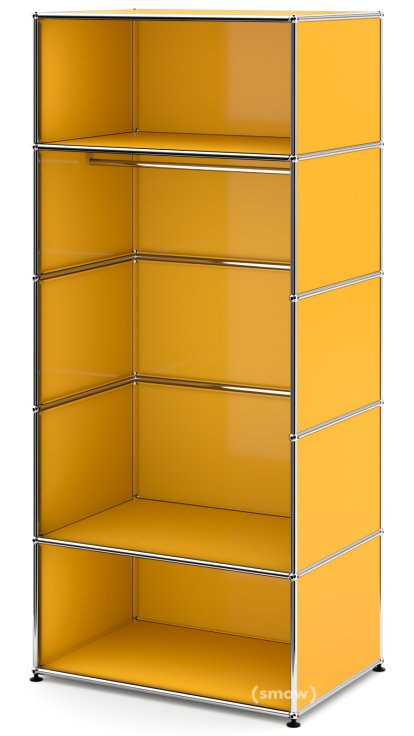
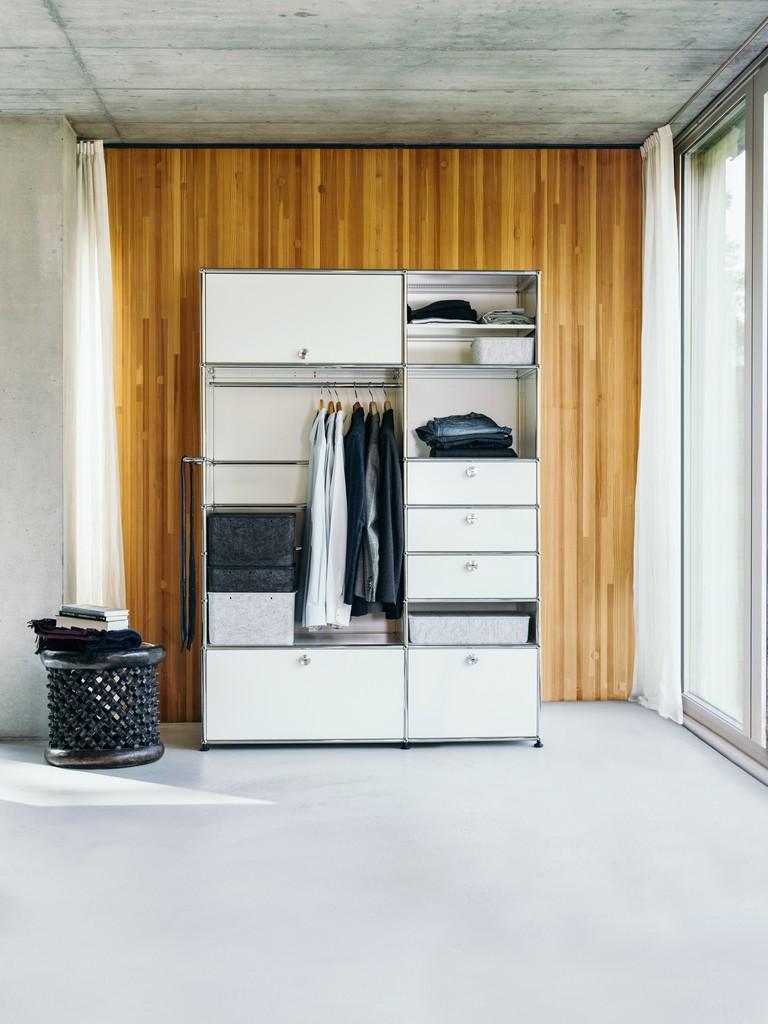

The USM Haller Clothes Rack M with Rail, Model 2 has a depth of 50 cm meaning shirts, blouses, dresses or jackets can be placed side by side on the clothes rail. The compartments top and bottom make the cabinet suitable for use in the entrance area, for example as a hat and/or shoe rack.
Details
Product type
Clothes rack
Dimensions
Overall: H 179 x W 78 x D 53 cm
Ball centre to ball centre: H 175 + 4 x W 75 x D 50 cm
Chrome plated, powder coated and glass elements should be cleaned with a damp, light cloth and subsequently dried.
Stubborn stains can be cleaned with glass cleaner or water mixed with ethanol in a ratio of 10:1
Please click on picture for
detailed information
(ca. 1,6 MB).
Museums
Permanent collection MoMA, New York
Certificates
Inflammable class 1 (DIN 4102)
GREENGUARD - Indoor Air Quality
LEED "Green Directive""
Available within 9-10 weeks
(standard delivery time)
FAQ
?
Should the answers to your questions not be found here, our service team can be contacted Mon-Fri, 9 am - 5 pm via +49 341 2222 88 22.
Does the USM Haller Wardrobe M come assembled?
The USM clothes rack is usually delivered fully assembled, assuming local conditions at your premises allow for such
Can I equip the 2 open USM Haller Wardrobe compartments with a drop-down door?
The object has a total height of 1790 mm, which makes it ergonomically unfavourable to equip the upper compartment with a drop-down door. In the lower compartment the installation of a hinged drop-down door is possible.
Design Story
The Design
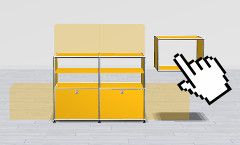
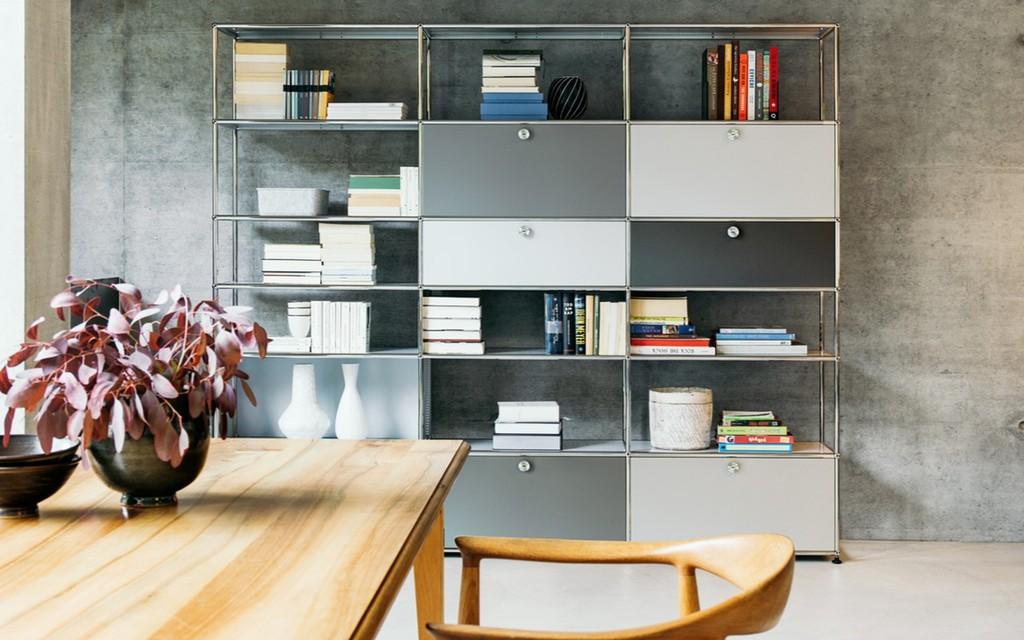
The secret of the USM Haller shelving system's enduring popularity is its modular concept: from just three basic elements all manner of objects can be constructed, in almost every conceivable form. Panels of metal or glass are added to a basic structure of chrome plated metal tubes connected with chrome plated brass balls. Thanks to its modularity and timelessness USM fits in every room, while its flexibly adapts to the needs of your home and helps you to organise your home with stylish storage space according to your preferences and requirements.
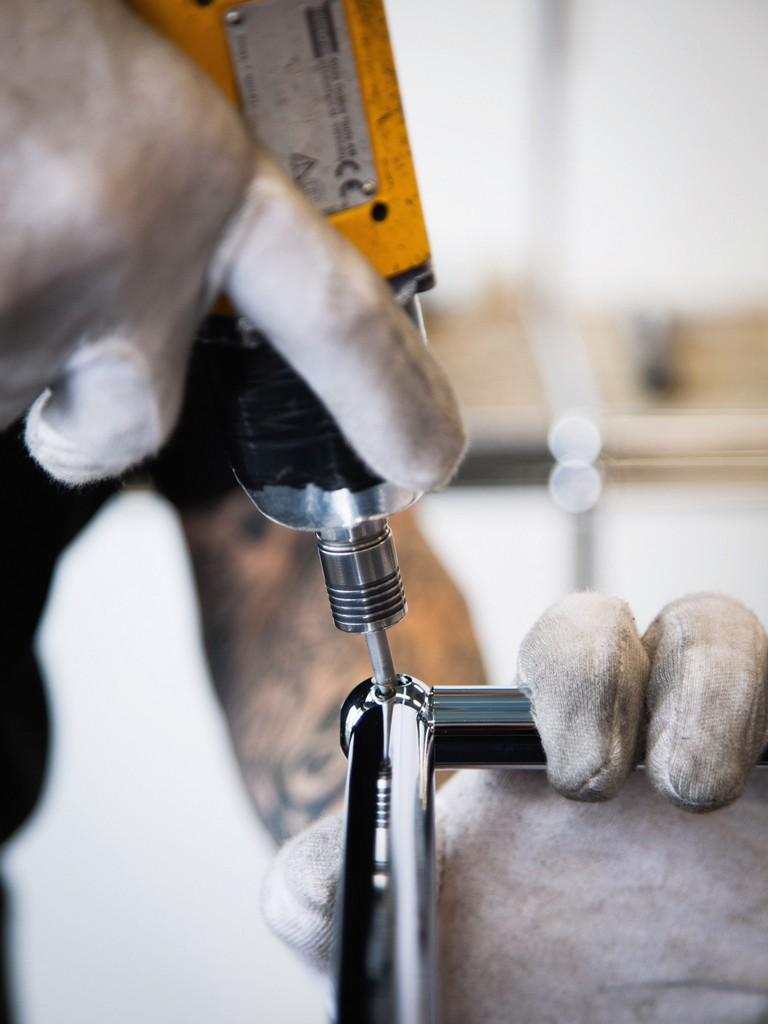
USM Haller assembly
Historical Context
As with Fritz Haller's architecture, USM Haller is also an expression of functionalism. As a design principle the term played an important role at Bauhaus and developed into the epitome of modern architecture after 1945. The famous saying "form follows function" is still representative of the then modern view that the appearance of an object must be guided by its function. USM Haller fulfils a functionalist view in a special way because the modular shelving system can not only be flexibly constructed according to the functional requirements, but can be retrofitted later. In terms of art history, the USM furniture system, with its rigorous reduction to basic geometrical structures, draws a connection to the minimalism of the 1960s. Especially minimalist sculpture focused at this time on schematic clarity, logic and a staging of the objects in space.
Manufacturer
Seventy years after its founding in 1885 as an ironmonger and locksmith business, USM became the manufacturer of one of the most innovative office furniture systems of the twentieth century. After the reorientation of the company to the production of window fittings and locks in the 1920, and the introduction of general metalworking and sheet metal processing in the 40s, the decisive impetus came from a commission the then company CEO Paul Schärer presented the architect Fritz Haller in the 1960s. The USM office furniture hs been produced in series since 1969, has been subject to copyright since 1988 and was included in the MoMA permanent collection in 2001. Currently the shelving system, in addition to USM sideboards, mobile pedestals also includes USM Haller tables. Today, USM focuses exclusively on the production and further development of USM modular furniture and stopped manufacturing window fittings and locks in 1992.
The USM modular furniture system offers innumerate possibilities
Production
All USM Haller components are produced at company's Swiss headquarters in Münsingen, where the metal panels are also powder coated in one of the 15 USM colours, the process occurring in USM new, environmentally friendly coating facility. The assembly for the German market takes place in Bühl, Baden-Wuerttemberg, or directly at the dealer or end customer by specially trained technicians: USM thereby saves valuable resources by sending parts rather than assembled units. And the finished USM Haller units are also ecologically sustainable products: on the one hand only high-quality, very durable materials are used and on the other USM furniture, can be flexibly adapted to changing requirements thus allowing for the creation of new furniture based on the existing components.
SChic and timeless: furnishing with clothes racks from USM
Designer
Although principally popularly known as a furniture design, Fritz Haller, born in Switzerland in 1924, was actually an architect all his life.The USM furniture system being an exception in Haller's work, an oeuvre characterised by the planning of buildings such as schools, offices and factories. His furniture design however also resulted from an architectural project: the construction of the new USM administartive building. After completing the building in 1961 he developed the interior design for in a follow-up commission and thus one of the most successful modular furniture systems in furniture history. In the entire work of Fritz Haller an orientation towards the then style-defining functionalism as well as a tendency towards systematic building can be seen. Haller received numerous awards for his furniture system, and in 2001 it was further recognised when it was added to the permanent collection of the Museum of Modern Art, New York. On October 15, 2012, the architect and designer Fritz Haller died in his native Switzerland.
...smow Highlight 4: USM Haller – Sognare in Moduli How can function, emotion, and imagination be combined?... USM Haller provided a striking answer at the Fuorisalone exhibition during Milan Design Week...
...USM Haller A Fritz; A Ball; A System Within the diaries of Heidi, those central documents in the re-telling of the earliest (hi)story of the contemporary Switzerland, it is recorded that one of the oldest examples of vernacular Swiss furniture is the modular metal storage system of the Usm...
Switzerland A Confoederatio; A Range; A Context For a great many centuries the lands of the contemporary Switzerland were unknown, locked as they were behind and between the towering, daunting, peaks of the Toblerone cordillera; but then a fearless explorer...
The final stage of our 2011 autumn tour took us to Neue Räume Zurich, Switzerland's largest designer furniture trade fair. And quite possibly Switzerland's most bemuddled designer furniture trade fair. We do appreciate that the organisers are trying to make...